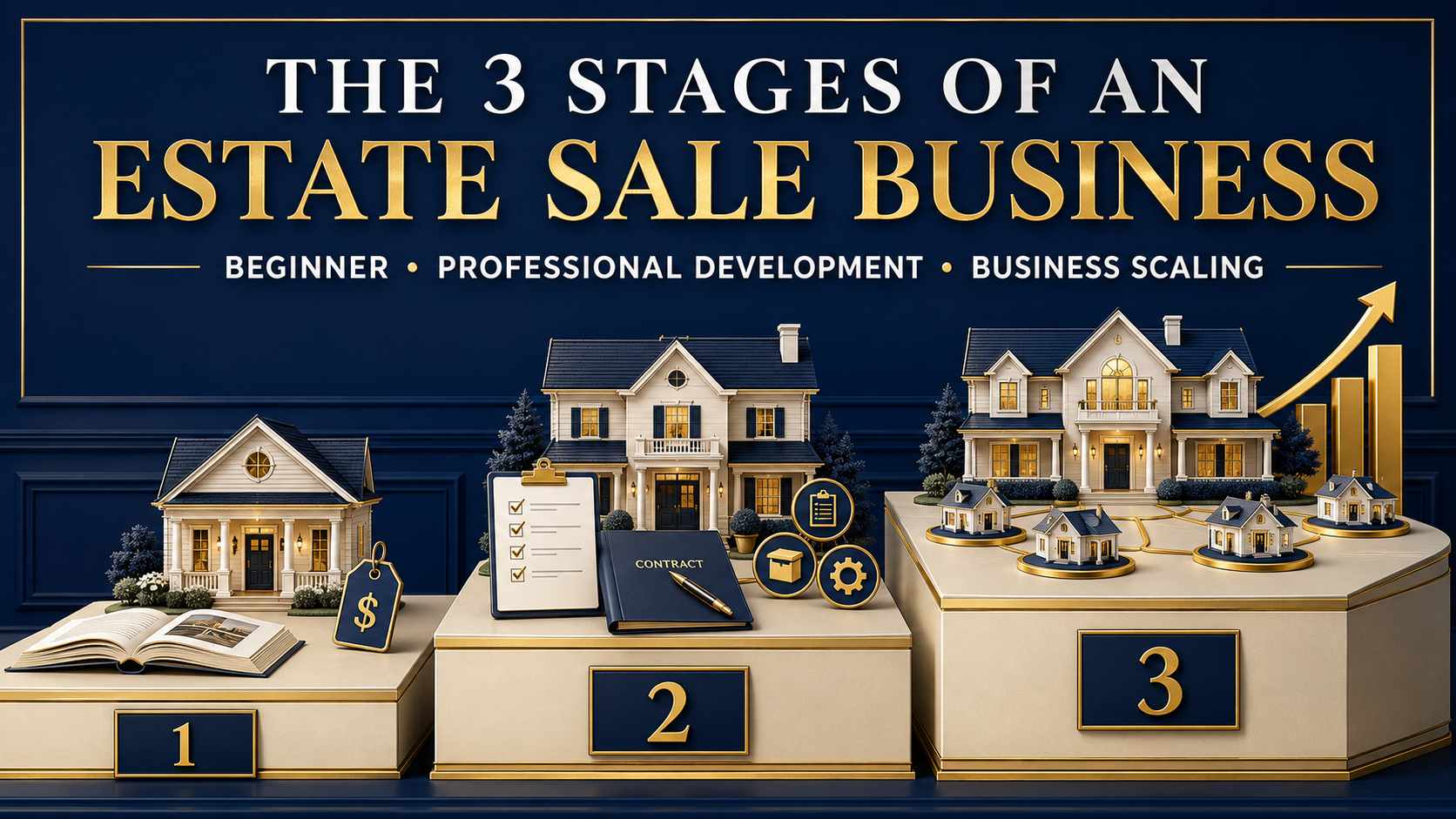
The Three Stages of Building an Estate Sale Business
Estate sale businesses evolve through three key stages: Foundations for new operators, Professional Development for refining practices, and Business Scaling for sustainable growth and expansion. Understanding your current stage helps you acquire the right education for success.
 By Jenna Pecor · July 21, 2026 · 4 min read
Key takeaways
- Estate sale businesses progress through distinct stages: Foundations, Professional Development, and Business Scaling.
- Each stage demands tailored education and skill development.
- Understand your current stage to choose relevant training.
- Scaling requires strong systems and capable teams, not just more sales.
- Continuous learning is vital for long-term success and sustainability.
Not every estate sale business needs the same kind of education at the same time.
Someone preparing for their first sale has very different needs from an experienced operator trying to manage multiple teams. That is why the Institute for Estate Sale Professionals organizes its education into three tracks: Foundations, Professional Development, and Business Scaling.
These tracks represent the three stages an estate sale business typically moves through as it grows.
Stage One: Foundations
The Foundations stage is for new and early-stage estate sale operators who are learning how to manage an estate sale from beginning to end.
At this stage, operators need more than a collection of pricing tips. They need to understand the complete estate sale process and how each decision affects the project, the client, and the business.
Foundational education may include:
Evaluating a potential sale
Creating a liquidation strategy
Estimating labor and establishing a realistic timeline
Organizing, staging, researching, and pricing
Marketing the sale
Managing sale days
Communicating with clients
Closing out the project and accounting for sale proceeds
The goal of this stage is to help operators develop a repeatable process. Instead of approaching every house as an entirely new problem, they begin building a framework they can use from one project to the next.
Stage Two: Professional Development
Once an operator understands how to conduct an estate sale, the next step is learning how to operate as a professional.
Experience alone does not automatically create professionalism. An operator may know how to stage a house or run a busy sale while still needing stronger contracts, better client communication, more accurate records, or clearer ethical standards.
Professional development may include:
Contracts and addendums
Fiduciary responsibilities
Conflicts of interest
Client communication and customer service
Pricing and valuation strategies
Technology and artificial intelligence
Marketing and client acquisition
Hiring and managing employees
Risk management
Industry standards and ethical decision-making
This stage helps operators strengthen the quality and consistency of their work. It is where someone moves beyond simply knowing how to hold an estate sale and begins developing the judgment, systems, and professional standards required to serve clients responsibly.
Stage Three: Business Scaling
Scaling is not simply booking more estate sales.
When a business grows without the right structure, the owner often becomes the bottleneck. Every question, decision, client issue, pricing concern, and employee problem still depends on one person. The company may be generating more revenue, but the owner is also working more hours and carrying more risk.
The Business Scaling stage focuses on creating a company that can handle additional volume without sacrificing service quality, accountability, or profitability.
Scaling education may include:
Creating standard operating procedures
Building leadership within the company
Managing multiple teams or simultaneous projects
Delegating decisions responsibly
Tracking labor, revenue, and profitability
Improving workflow and productivity
Selecting and implementing business systems
Developing additional revenue streams
Expanding into new service areas or markets
Building a long-term business strategy
Preparing the business for franchising
The goal is not growth for growth’s sake. The goal is sustainable growth supported by strong systems and capable people.
How Do You Know Which Stage You Are In?
The stages are not determined only by how many years you have been in business.
An operator may have several years of experience but still need foundational systems. A newer operator may already have strong business experience and be ready for professional-development education sooner than expected. An established company may be successful financially but not yet have the structure required to scale.
You may be in the Foundations stage if you are still learning how to plan and complete estate sale projects consistently.
You may be in the Professional Development stage if you can conduct a sale but want to strengthen your contracts, systems, judgment, client experience, and professional standards.
You may be in the Business Scaling stage if demand has grown beyond what you can personally manage and you need systems, leaders, and processes that allow the company to operate effectively without your involvement in every detail.
You may also need education from more than one track. Business development is rarely perfectly linear. An operator preparing to scale may discover a weakness in a foundational process that needs to be corrected first.
Education Should Grow With Your Business
The education an estate sale operator needs changes as the business develops.
In the beginning, the most important question may be, “How do I conduct an estate sale?”
Later, it becomes, “How do I conduct every sale consistently, ethically, and professionally?”
Eventually, the question becomes, “How do I build a business that can grow beyond what I can personally do?”
Understanding your current stage allows you to choose education that addresses the challenges you are actually facing—not just the topics that sound interesting.
Whether you are preparing for your first project, strengthening an established operation, or building a company capable of managing multiple teams, there is always a next stage of development. The goal is to identify where you are now and build the knowledge, judgment, and systems you will need to move forward.
To see the full catalog of course and certification offerings, go to https://instituteforestatesaleprofessionals.org/
Frequently asked questions
I’m Jenna Pecor, founder of Jennarocity Estate Sales and the Institute for Estate Sale Professionals. I have worked in the estate sale industry since 2014 and am also a licensed Texas REALTOR® with a Project Management Certificate from Texas Tech University. My experience allows me to understand estate sales from multiple perspectives, including property transitions, client relationships, contracts, project planning, pricing, team management, and the responsibility of being entrusted with an entire household. I stay at the forefront of the industry by continually developing and testing better methods for estate sale operators to meet their clients’ changing needs. My teaching is grounded in real-world experience, not just theory. Through realistic scenarios, practical strategies, and lessons learned from operating my own company, I help students understand why professional standards matter, make better decisions, protect their clients, and build stronger estate sale businesses.
More from the blog
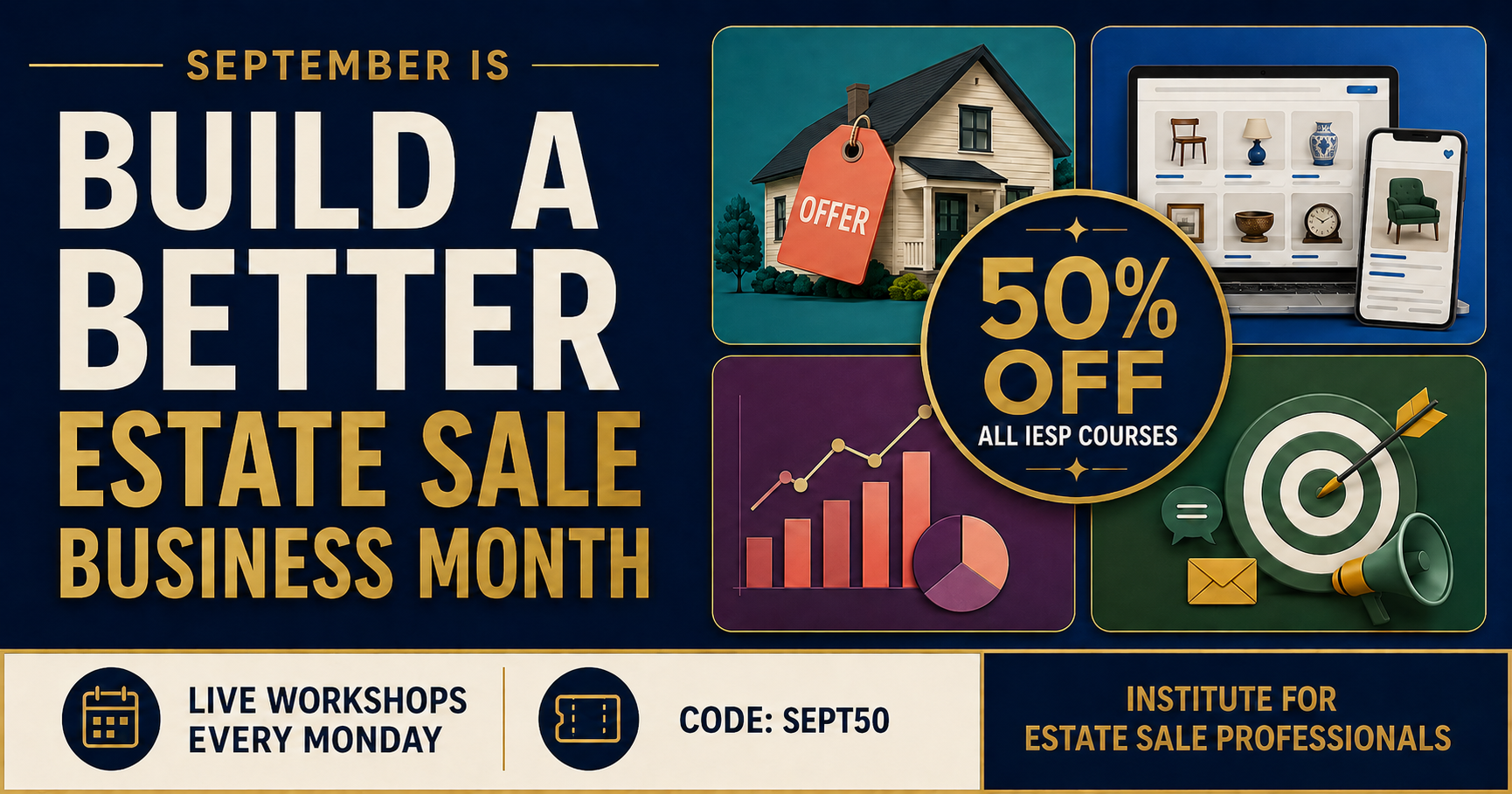
September Is “Build a Better Estate Sale Business” Month at IESP
This September, the Institute for Estate Sale Professionals (IESP) dedicates the month to helping operators build better businesses. Access 50% off all courses and join weekly interactive workshops.

A Play About an Estate Sale—and the Grief Hidden Inside the Stuff
A new play, 'Estate Sale,' explores the profound grief and emotional challenges families face when clearing a loved one's home, revealing how personal objects embody a lifetime of stories beyond their market value.

Think Beyond Social Media: Become Your City’s Estate Sale Expert
Move beyond social media and learn how to position yourself as the trusted estate sale expert in your community. Build strategic relationships and educate local professionals to secure valuable referrals.