A Play About an Estate Sale—and the Grief Hidden Inside the Stuff
A new play, 'Estate Sale,' explores the profound grief and emotional challenges families face when clearing a loved one's home, revealing how personal objects embody a lifetime of stories beyond their market value.
 By Jenna Pecor · August 5, 2026 · 4 min read
Key takeaways
- Estate sales are deeply emotional experiences, not just transactions.
- Personal objects hold significant emotional and historical value for families.
- Clearing a parent's home is often seen as an 'impossible task'.
- Estate sale professionals must balance market value with family grief and history.
- Belongings preserve personal mythologies and reveal aspects of lives lived.
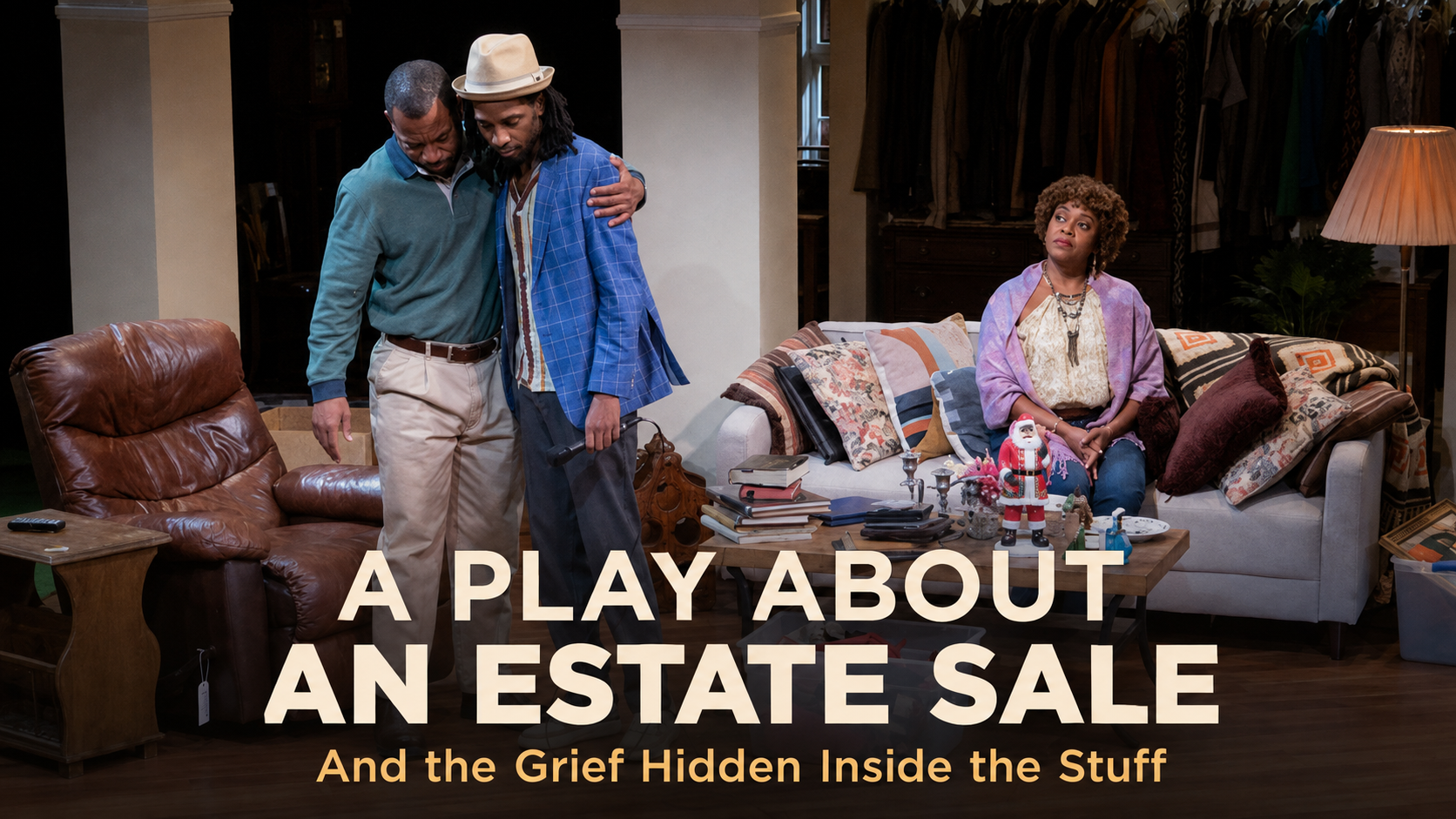
From left: Blake Morris, Jayson Lee, and Gillian Glasco. Photo by Roman Iwasiwka, taken from the Barrington Stage Company Website
When most people hear the words “estate sale,” they probably picture furniture with price tags, crowded tables, bargain hunters and a house full of belongings that need to be sold.
But a new play called Estate Sale explores what is happening beneath all of that.
Written by award-winning playwright Keelay Gipson, the semi-autobiographical play follows a grieving son faced with the overwhelming task of clearing his deceased parents’ home. The world-premiere production was presented by Barrington Stage Company in Pittsfield, Massachusetts, from June 30 through July 25, 2026.
What immediately caught my attention was how the play was described:
“The objects of our lives inform, reveal, and preserve our personal mythologies.”
As an estate-sale professional, I understand exactly what that means.
A House Full of Objects—and a Lifetime of Stories
The main character in Estate Sale is known as the Executor. After losing both of his parents, he must decide what to do with the physical contents of their lives.
The production reportedly began before the traditional performance even started. Audience members entered through a staged home filled with neatly arranged belongings and objects marked with prices. They were not simply watching a story about an estate sale; they were placed inside one.
That is an incredibly fitting way to tell this story.
When we enter a home to conduct an estate sale, we do not just find furniture, dishes, clothing and collectibles. We find evidence of the people who lived there.
A worn chair may be where someone sat every morning with a cup of coffee. A set of dishes may have been used for every family holiday. A sewing machine, record collection or box of handwritten recipes may represent a part of someone’s identity that their children never fully understood until they began opening drawers and sorting through closets.
To a shopper, these things have prices.
To the family, they have stories.
The Impossible Task of Clearing a Parent’s Home
The description of the play calls clearing the home an “impossible task.” That may sound dramatic to someone who has never experienced it, but it is often exactly how families feel.
They are not simply deciding whether to keep or sell an object. They may feel as though they are deciding which parts of their parents’ lives deserve to remain.
What happens to the dining table where the family gathered? Who keeps the photographs? Is it acceptable to sell a gift that a parent treasured? What if no one has room for the things that were once important?
Sometimes an object is not especially valuable in the marketplace, but it carries enormous emotional value. Other times, a family holds onto something because releasing it feels too much like releasing the person.
That is what makes an estate sale different from an ordinary sale. It usually exists because a family is experiencing a major transition—and very often, a significant loss.
When Personal Memories Become Merchandise
One of the hardest parts of an estate sale is the transformation that takes place inside the home.
Personal belongings must be organized, evaluated, photographed and priced. Objects that once existed within the private life of a family are suddenly displayed for strangers to examine and purchase.
A shopper sees a $10 ceramic figurine.
The family may see the figurine that sat in their mother’s kitchen for 30 years.
Neither perspective is wrong. The shopper does not know the story, and the family cannot realistically keep every object connected to a memory. But the gap between those two perspectives is where much of the emotion of an estate sale lives.
A professional estate-sale company must understand both sides. We have a responsibility to market and sell the contents of the home, but we are also working inside someone’s grief, history and family relationships.
The Stuff Is Never Just Stuff
I have often said that the contents of a home have equity, much like the home itself. They have financial value that should be protected and managed carefully.
But Estate Sale points toward another kind of equity: emotional and historical equity.
Our belongings preserve pieces of us. They show what we valued, how we spent our time and what kind of life we created. They can also reveal family stories, conflicts and parts of our parents’ identities that we may not have fully understood while they were alive.
Eventually, most of those belongings will leave the family’s possession. That does not mean the memories leave with them.
The purpose of an estate sale is not to determine which objects were meaningful enough to prove that a life mattered. It is to help a family move through a necessary transition while treating the home, its contents and the people connected to them with respect.
A Story the Estate-Sale Industry Should Pay Attention To
I wish I had known about Estate Sale while it was being performed because it approaches this work from a perspective our industry needs to understand.
Estate-sale professionals often focus on pricing, marketing, labor, contracts and sales results. Those things matter. But our work also places us inside some of the most personal and emotionally complicated moments of people’s lives.
We are not just clearing houses.
We are helping families decide what they will carry forward, what they are ready to release and how the physical contents of one life will become part of someone else’s.
That is why an estate sale is never just about the stuff.
It is about the people who owned it, the family left behind and the stories that remain—even after the house is empty.
Estate Sale was written by Keelay Gipson and directed by Steph Paul. The world-premiere production was presented by Barrington Stage Company in the summer of 2026.
Frequently asked questions
I’m Jenna Pecor, founder of Jennarocity Estate Sales and the Institute for Estate Sale Professionals. I have worked in the estate sale industry since 2014 and am also a licensed Texas REALTOR® with a Project Management Certificate from Texas Tech University. My experience allows me to understand estate sales from multiple perspectives, including property transitions, client relationships, contracts, project planning, pricing, team management, and the responsibility of being entrusted with an entire household. I stay at the forefront of the industry by continually developing and testing better methods for estate sale operators to meet their clients’ changing needs. My teaching is grounded in real-world experience, not just theory. Through realistic scenarios, practical strategies, and lessons learned from operating my own company, I help students understand why professional standards matter, make better decisions, protect their clients, and build stronger estate sale businesses.
More from the blog

September Is “Build a Better Estate Sale Business” Month at IESP
This September, the Institute for Estate Sale Professionals (IESP) dedicates the month to helping operators build better businesses. Access 50% off all courses and join weekly interactive workshops.

Think Beyond Social Media: Become Your City’s Estate Sale Expert
Move beyond social media and learn how to position yourself as the trusted estate sale expert in your community. Build strategic relationships and educate local professionals to secure valuable referrals.
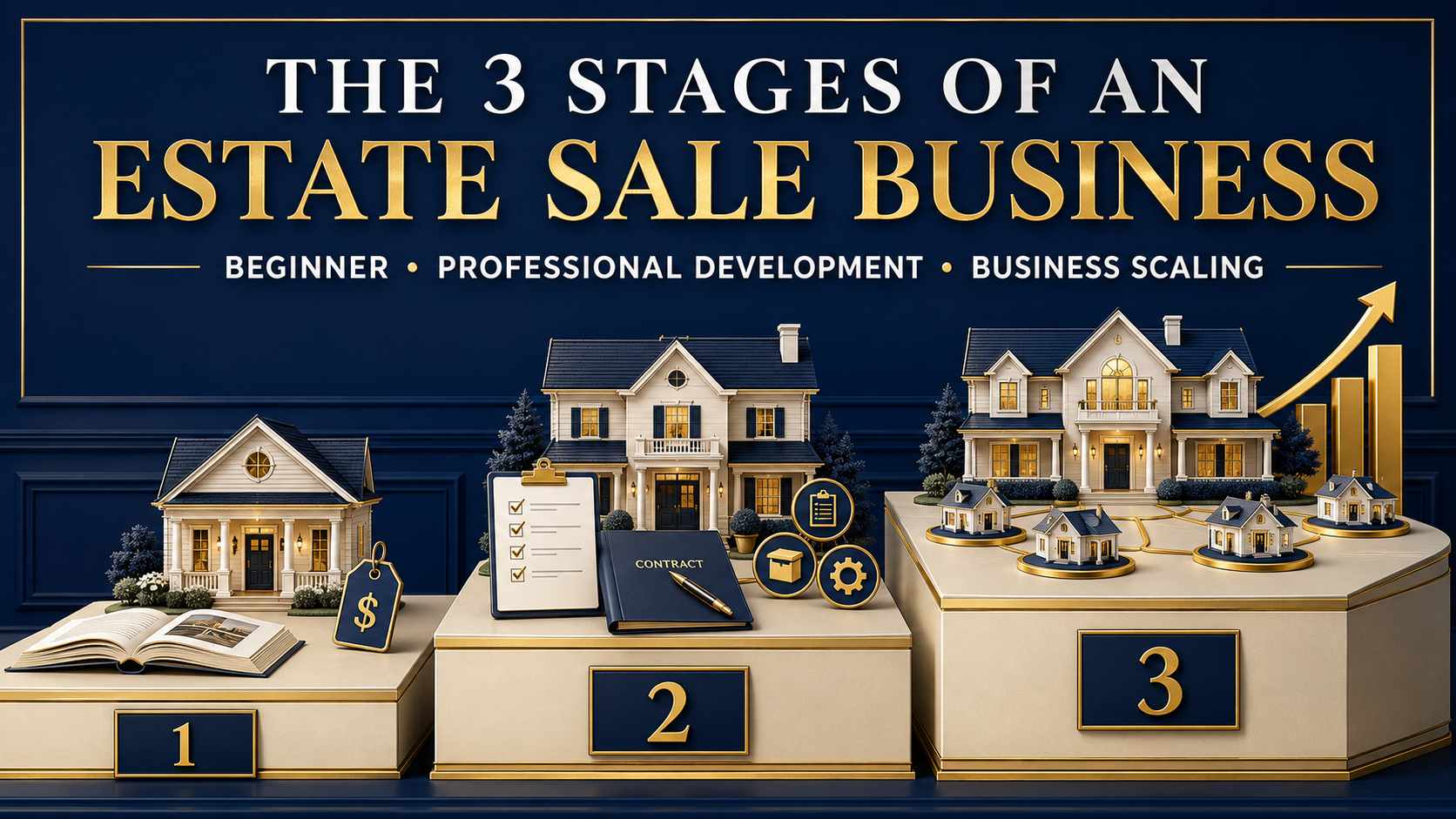
The Three Stages of Building an Estate Sale Business
Estate sale businesses evolve through three key stages: Foundations for new operators, Professional Development for refining practices, and Business Scaling for sustainable growth and expansion. Understanding your current stage helps you acquire the right education for success.